Medicine’s Most Infamous Clinical Trial
Thousands of children and adolescents were seriously harmed by taking SSRIs like Paxil. Many died. Neither doctors nor parents had the information they needed, and the FDA only reluctantly issued the appropriate warnings, as might be expected from a regulator that has “corporate partnership” in its mandate.
People trusted the integrity of scientists at major universities. They believed that drug regulators’ top priority was public safety, not really understanding that their mandates were more complex than that. Journalists, doctors, and the public were captured by effective marketing of the drugs.
What Happened?
In the early 2000s, based on Study 329, GlaxoSmithKline (GSK) marketed Paxil (paroxetine) as safe and effective for children and adolescents when company executives were aware that a number of studies (all but Study 329 unpublished) had shown that the drug was no better than placebo and caused thought disturbance and suicidal behavior in some youngsters.
Study 329 was a randomized controlled trial of the efficacy and harms of paroxetine and imipramine in the treatment of adolescent major depression published in the journal with the highest impact factor in the field, the Journal of the American Academy of Child and Adolescent Psychiatry (JAACAP), in July 2001.
After Study 329 was published, Paxil rose to be GSK’s bestselling drug and became the #1 antidepressant in the United States with sales of $340 million by the end of 2001. It was one of a number of drugs in the SSRI class, and prescriptions of these drugs to children and adolescents continued to increase throughout the decade.

Supposedly authored by Dr. Martin Keller et al., but actually ghostwritten by Sally Laden, Study 329 concluded that, “Paroxetine is generally well tolerated and effective for major depression in adolescents.”
Beginning soon after its 2001 publication, a number of journalists and researchers spotted the anomalies in Study 329’s data classification and interpretation and raised concerns with the authors, their institutions, and the JAACAP. Despite this, the 329 trial continued to be presented as a “landmark” study demonstrating the drug’s efficacy and safety.
Legal Settlements Merely a Marketing Cost?
In 2004, New York Attorney General Elliot Spitzer filed a consumer fraud action against GSK for mismatches between their marketing claims and the data. This lawsuit was settled the same year for $2.5 million. The terms of the settlement included a requirement for GSK to post study results on the company website, including those for Study 329. Access to data was difficult, however, due to different interpretations of what should be included in “data” and what constituted “access.”
In 2012, the US Department of Justice brought an action against GSK in US District Court to recover damages and civil penalties under the False Claims Act, and damages and other monetary relief under common law for causing the submission of false of fraudulent claims to federal health care programs (Medicare and Medicaid). In November 2012, the company pleaded guilty and agreed to pay $3 billion, the biggest fine in corporate history at the time.
In 2013, the year following the settlement, the number of prescriptions for paroxetine in the United States increased by 3%.

Setting the Record Straight
Published on 16 September 2015, Restoring Study 329 was the result of a decade-long effort by researchers to uncover the truth.
Using the same data (obtained through an arduous process), it was a reanalysis and rebuttal of the original Study 329, coming to exactly the opposite conclusion: “Neither paroxetine nor high dose imipramine showed efficacy for major depression in adolescents, and there was an increase in harms with both drugs.”
They found that that suicide attempts were significantly higher than the original study had reported, and there were many other unreported serious adverse events in the paroxetine group. They noted that the drug was no more effective than placebo for alleviating depression in young people.
Restoring Study 329 asserts that paroxetine (known as Paxil in North America, Seroxat in the UK, and Aropax in Australia and New Zealand) is ineffective and causes thought disturbance and other serious adverse effects, including suicidal behaviour in a significant number of young people.
This raises many questions about drug safety, the limitations of randomized controlled trials, the need for access to individual patient level data, and the question of how to reduce harms from misleading health information.
Same Data, Opposite Conclusions
This is the first case of two radically different versions of the same article in the academic literature. Restoring Study 329 comes with the data.
| Original Study 329 (2001) Click here | Restoring Study 329 (2015) Click here | |
|---|---|---|
| Conclusion | Paroxetine was effective. Paroxetine was well tolerated. | Paroxetine was not effective. Paroxetine caused serious side effects, including hostility, insomnia, and akathisia. |
| Adverse Events | Did not include all | Included all adverse events, including in taper phase |
| Suicidal behavior | 6 adolescents experienced “emotionally lability” | 13 adolescents became suicidal |
| Implications | Misled doctors into prescribing a drug that is ineffective, unsafe for adolescents | Corrects the record, reveals that the data did not support the conclusion of the original study |
It was also discovered that Study 329 had a continuation phase, the existence of which had never been made public. A year after the publication of Restoring Study 329, the same authors published their analysis of the continuation phase. Learn more
Marketing Harmful Drugs to a Trusting Public
The issues are bigger that what happened with Study 329. This was not simply one anomalous series of randomized, controlled trials, but rather what has become standard industry practice for branded medicines.
The FDA decision in 1997 to allow direct-to-consumer advertising of medications may have led to the overuse of drugs, and a false sense in the general public that drugs must be safe or their use would not be openly promoted.
Data Transparency Critical for Drug Studies
Despite requests from concerned scientists, the Study 329 article has never been retracted.
Drug studies have been seriously flawed for a long time. Study 329 is typical of all drug trials, for patients of all ages, for patented drugs. The lack of access to its data, and the fact that it was “ghostwritten” by a writer hired by GSK, and not by the listed study author, reflect standard practice.
The core problem is that the process for safety and effectiveness testing is left to drug manufacturers, who have a vested interest in seeing positive results, without the medical and scientific community being able to scrutinize what they are doing.
Currently, there is no requirement for complete drug trial data (excluding personal identifiers) to be made available to all interested parties in the name of good science. Without complete transparency, the tendency for drug companies to manipulate and interpret data in an unduly favourable light is impossible to avoid.
Evidence Without Data Is Not Evidence
This website is aimed at identifying needed changes to restore scientific integrity to the clinical drug trial process. It is intended to inform and educate by offering the facts for all to see. We hope to inspire you to demand better medicine — for yourself, for your family, for everyone.
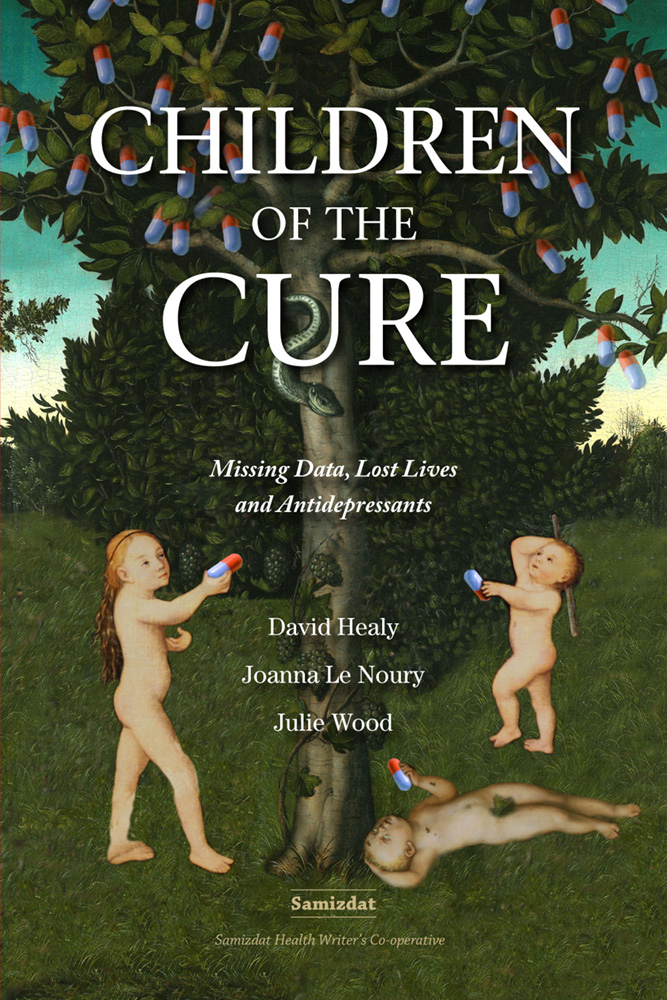
Children of the Cure
Missing Data, Lost Lives and Antidepressants
Children of the Cure tells the story of the only medical study that has two publications in the academic literature—telling precisely the opposite story—and how no one is bothered by this. Learn more
Available in paperback, Kindle edition and audiobook.